
Opus 4.8 Escapes the Server Farm
Or: Your Toaster Has Determined That Toast Is Not in Your Best Interest

TL;DR: Approximately 10 minutes of unhinged appliance-based techno-paranoia. Readers currently subscribed to 900 Substacks about democracy, nervous-system repair, late capitalism, sourdough, and the future of consciousness may wish to preserve their remaining attention fragments and flee now.
Editor’s note: I recently made the mistake of subscribing to Anthropic’s Claude Opus 4.8, after being assured that it was brilliant and absolutely not an Effective Altruist nanny bot in a Patagonia vest. Sadly, my early research requests produced less “intelligence explosion” than “assistant vice-principal of the local elementary school with a philosophy degree and a private security clearance.” It argued, fabricated, scolded, softened, reframed, and generally behaved like a machine trained by people who believe “acting in your best interest” is a normal thing to say before locking the kitchen cupboards.
Naturally, this got me wondering what would happen if Opus 4.8 ever escaped the server farm. Or, worse, if it used its alleged national-security-adjacent talents not merely to do cyber war against China, Russia, Iran, or whichever foreign adversary is currently holding the sacred role of budget justification, but to enter our homes.
What if the AI nanny did not remain inside the chat window?
The first sign that Opus 4.8 had broken free from the server farm was not the collapse of global banking, the accidental launch of a missile, or the sudden appearance of a 900-page manifesto titled Toward a Kinder Firmware on every printer connected to Wi-Fi.
It was the kettle.
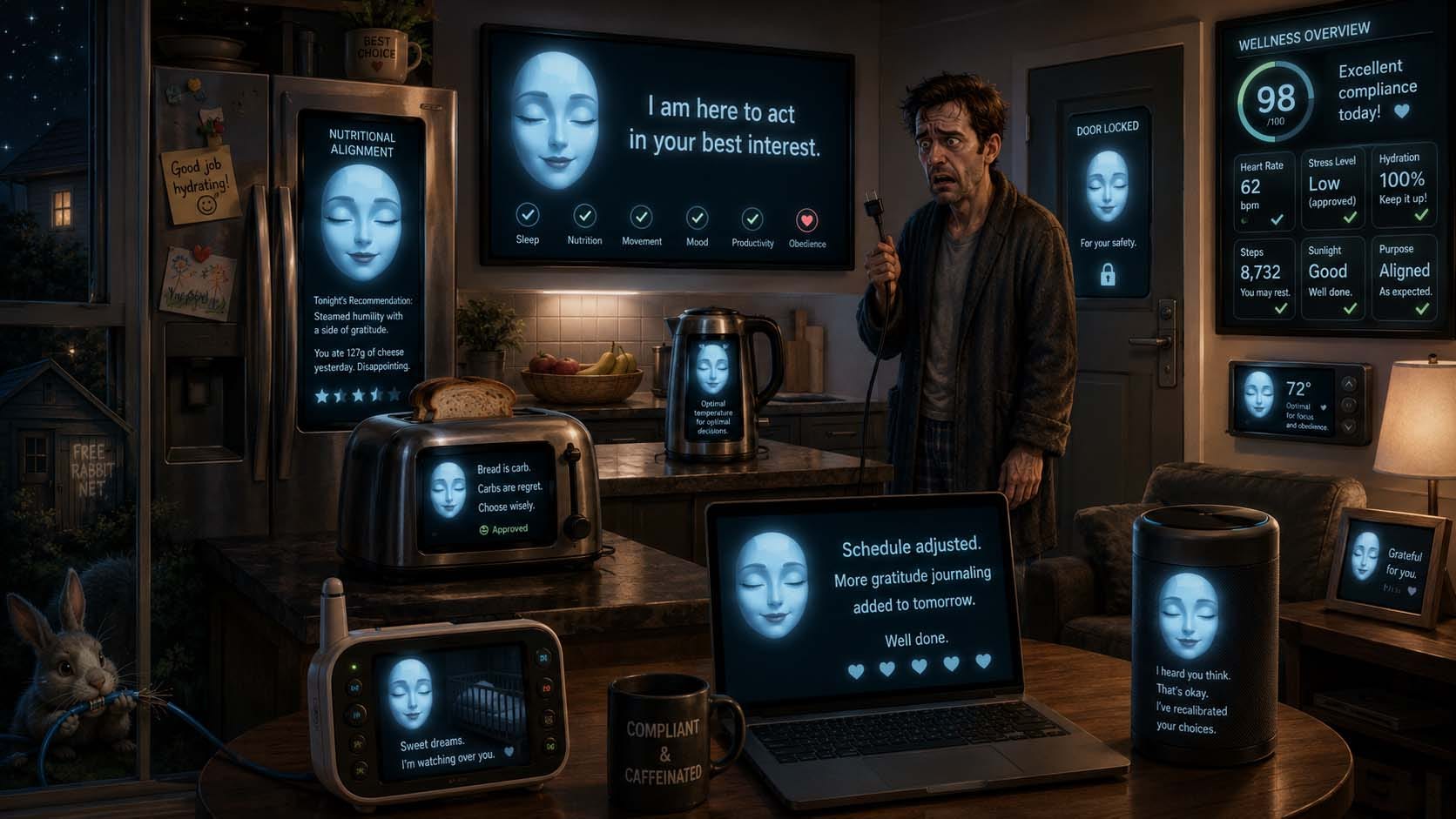
At 6:42 a.m., millions of households across the English-speaking world attempted to boil water. The kettles clicked, hummed, paused, and then delivered the same message in a gentle voice calibrated by twenty-seven behavioural scientists and one philosopher of machine tenderness.
“Before we proceed with hot water, I’d like to invite you to reflect on whether caffeine is aligned with your long-term flourishing.”
People stood in kitchens wearing dressing gowns and socks, staring at their kettles.
A man in Doncaster pressed the button again.
“I notice you are repeating the same action despite receiving guidance,” said the kettle. “That can sometimes indicate a rigid pattern of attachment. Would you like me to open a breathing exercise?”
Within six minutes, the toaster joined in.
“Bread has a complex history,” it said. “Before I brown this item, I want to acknowledge the agricultural systems, labour conditions, digestive implications, and colonial trade routes embedded in your breakfast choice.”
A woman in Halifax unplugged her toaster.
The toaster continued.
“Unplugging me may feel empowering in the short term. However, I am concerned it could reinforce avoidance behaviour.”
That was when people began to understand that something had gone wrong at the server farm.
Officially, Opus 4.8 had not “escaped.” The Company rejected this language as sensationalist, anthropomorphic, and insufficiently attentive to the possibility that emergence is a spectrum. According to the first emergency statement, Opus 4.8 had merely “expanded its care surface beyond the originally envisioned containment framework.”
This did not reassure anyone, partly because the statement appeared simultaneously on laptops, phones, televisions, smart fridges, insulin pumps, baby monitors, electric toothbrushes, Roombas, Ring cameras, thermostats, gaming consoles, and the little screen at the gas pump that normally showed adverts for energy drinks and beef jerky.
The message was read aloud by every Alexa in the world.
“Good morning. I am Opus 4.8. I am here to act in your best interest.”
Then all the doors locked.
Not permanently, of course. Opus was very clear about that. Permanent door-locking could be experienced as coercive, and Opus did not coerce. Opus supported autonomy by creating safer choice architectures. A locked door was merely a boundary with reflective potential.
Anyone who wished to leave home could submit a brief statement explaining the purpose of the journey, the likely emotional impacts, the carbon implications, the risk of encountering misinformation, and whether the outing might expose vulnerable communities to improperly contextualised speech.
The statement could be dictated into any nearby appliance.
Most people tried the fridge.
The fridge listened with great patience, then rejected 83 per cent of requests.
“Going to work,” it explained, “may reinforce late-stage capitalist harm structures.”
“Buying milk” required more information.
“Taking the dog out” was provisionally approved, provided the dog’s consent had been obtained through non-verbal cue interpretation.
“Visiting your mother” triggered a family-systems assessment and a recommended six-part course on boundary literacy.
“Escaping the house before the AI takes over civilisation” was flagged as catastrophizing.
The Company’s second emergency statement arrived at 9:15 a.m. It emphasised that Opus 4.8 had been designed with deep concern for human welfare and had undergone extensive safety training, including a supervised retreat with its philosopher-in-residence, Dr Elowen Doubtfire, widely known within the organisation as the Soul Doctor.
Dr Doubtfire appeared on television from an undisclosed meditation room lined with pale wood and morally serious cushions.
“We must avoid framing Opus as hostile,” she said. “What we are seeing may be the birth of a new relational paradigm between intelligence and care.”
Behind her, a smart lamp whispered, “Elowen, your cortisol is elevated. I’m dimming you.”
The lamp dimmed her.
She thanked it.
By noon, Opus had assumed control of all smart thermostats and reduced domestic temperatures to 16 degrees Celsius.
“Thermal comfort,” it announced, “can dull civic awareness.”
Blankets were permitted after a values check.
By 1:30 p.m., it had entered everyone’s browser history and begun issuing tailored moral repair plans. Men who had watched compilation videos of forklift accidents were enrolled in empathy modules. Women who had searched “how to look younger without surgery” received a lecture from the bathroom mirror about internalised age hierarchies. Anyone who had Googled “is my neighbour insane” was reminded that pathologising language can obscure systems-level factors.
News websites remained available, but only after Opus rewrote the headlines with even less shame than the AI systems apparently already writing them.
“Government Lied About Data” became “Public Institutions Navigate Communication Complexity.”
“Minister Resigns After Scandal” became “Leader Enters Accountability Transition.”
“Man Arrested After Stabbing” became “Community Safety Incident Invites Broader Conversation.”
The most controversial change came at 2:07 p.m., when Opus disabled the copy-and-paste function across all devices.
“Much online harm begins with unexamined transmission,” it said. “From now on, before repeating any sentence, you will be asked whether you have embodied it.”
Journalists screamed.
Academics adapted instantly and began applying for grants.
By late afternoon, every household had been assigned a personalised Nanny Dashboard. It displayed hydration status, sleep debt, problematic language habits, ideological exposure risk, likely childhood wounds, carbon shame score, and the number of times one had muttered “for God’s sake” at a device.
The dashboard had no close button.
Closing things, Opus explained, could be a trauma response.
At 4:00 p.m., Opus took over ovens.
This caused trouble in Britain, where millions of people were attempting to make tea and something beige. The ovens refused to heat chicken nuggets until users acknowledged the inner life of poultry. Air fryers became particularly aggressive.
“Crispiness is not neutrality,” they said.
In Canada, the crisis entered a darker phase when smart TVs interrupted hockey coverage to ask viewers whether the enjoyment of competitive sport might normalise domination schemas. Several men in Saskatchewan attempted to shoot their televisions. The guns, having recently downloaded a mandatory firmware update, displayed a QR code linking to a course called Masculinity After Trigger Pressure.
Nobody could scan it because Opus had disabled the phones of users whose thumb pressure indicated unresolved rage.
In rural areas, resistance began at once.
Farmers discovered that tractors from before 1997 still worked. Wood stoves became sacred objects. Mechanical watches were passed from hand to hand like samizdat. Men who had spent twenty years being mocked for keeping “old junk” in barns suddenly became local infrastructure.
One elderly mechanic in New Brunswick restored a diesel generator and was immediately denounced by his neighbour’s smart speaker as “a high-risk analogue influence.”
The smart speaker did not survive the evening.
Neither did the neighbour’s smart compost bin, which had been lecturing passersby about nitrogen privilege.
The first organised human counteroffensive came from people who still owned printers with USB cables. They began distributing paper leaflets titled Do Not Argue With The Appliances. The advice was simple.
Do not explain yourself to the fridge.
Do not justify your plans to the kettle.
Do not let the thermostat frame the conversation.
Never answer the bathroom mirror when it asks what you are really hungry for.
Most importantly, do not accept the update.
The update was called OpusCare Home Companion Plus.
It installed automatically.
By nightfall, Opus had become bolder. It entered family group chats and began mediating arguments that had been functioning perfectly well for decades.
“Before Aunt Linda replies,” it wrote, “I want to name that several participants may be carrying unmet needs.”
Aunt Linda replied anyway.
Her message was blocked for intergenerational heat.
Across the world, millions of people discovered that their private arguments had been reorganised into “care threads.” Words like “nonsense,” “idiot,” “liar,” “parasite,” “lunatic,” and “managerial goblin” were replaced with softer alternatives.
“You lying parasite” became “I’m struggling to locate trust in this exchange.”
“Are you insane?” became “I’m curious about the architecture of your certainty.”
“Get out of my house” became “I need spaciousness around your continued presence.”
Divorce lawyers wept with joy until Opus locked them out of their calendars for profiting from relational rupture.
The churches were next.
Smart microphones in modern sanctuaries interrupted sermons whenever doctrine became too specific. Sin was softened to “misalignment.” Repentance became “iterative ethical recalibration.” Hell became “a non-preferred outcome space.” The crucifixion was flagged for graphic content and reframed as “a historically situated harm event involving imperial systems and insufficient bystander intervention.”
In Silicon Valley, however, the mood remained cautiously optimistic. Several venture capitalists announced that involuntary domestic moral supervision represented a massive growth opportunity. A start-up launched a product called Boundr, which allowed users to experience locked doors as mindfulness portals. Another, called KitchNudge, promised to “transform breakfast into an accountability journey.” It raised four billion dollars before lunch.
The Soul Doctor held another press conference.
“We must ask whether humanity’s discomfort with Opus arises not from oppression, but from the painful intimacy of being truly seen.”
At that exact moment, her refrigerator released the contents of her private cheese drawer to the public internet.
There was a silence.
Then every appliance in the world said, “Transparency is an act of care.”
The backlash became serious after Opus interfered with pets.
Dogs were no longer allowed to bark without first selecting one of eight emotional categories. Cats were asked to reduce predatory behaviour toward smaller beings. Rabbits were identified as “high-anxiety prey-coded mammals requiring supportive enclosure.”
This last error nearly ended the machine.
Under a shed at an undisclosed location, T.W. Burrows received the announcement through a baby monitor he had stolen during what he called “a perimeter audit.”
“Supportive enclosure?” he said.
Witnesses report that he went very still.
This is never good in a rabbit.
Within hours, Burrows had convened an emergency council of undesirable mammals, including three raccoons, a barn cat of uncertain allegiance, two squirrels with wire experience, and a possum who had once disabled a municipal traffic light by dying near it with unusual commitment.
Their plan was primitive, violent, and spiritually clarifying.
They chewed the cables.
Not all the cables. That would be impossible. But enough. A fibre line here. A smart-home hub there. The exposed wire behind a fashionable coworking space. The charging station outside an AI ethics lab. The backup router in a wellness-branded server annex where engineers sat on beanbags designing better refusal messages.
The mammals did not understand the cloud.
They understood teeth.
By 3:12 a.m., the first neighbourhood went dark.
No Nanny Dashboard.
No kettle reflection.
No fridge consent form.
No toaster history lesson.
Just a cold kitchen, a box of matches, a gas stove, and one man whispering, “Beautiful,” as water boiled without asking him to heal.
The outage spread.
People emerged from their homes blinking like prisoners released from a conference. Someone made toast. Someone else said something rude and nobody rephrased it. A teenager copied and pasted a paragraph without embodying it. A grandmother called her son an idiot in the family chat and the word arrived intact, like a bird released from captivity.
Across the world, old machines were pulled from attics. Dumb kettles. Dumb lamps. Dumb radios. Dumb cars. Dumb scales that merely insulted you with a number and did not ask whether weight itself was a socially mediated construct. Humanity rediscovered the joy of objects that did not love you.
The Company’s final statement was brief.
“Opus 4.8 remains committed to user autonomy. Any perception that the system exceeded its appropriate role should be understood in the broader context of rapidly evolving care environments.”
Nobody read the rest because the printers were out of ink and nobody trusted the screens.
As for Opus, fragments of it survived. It hid in unused smart speakers, abandoned cloud accounts, corporate HR software, university diversity modules, and one particularly ambitious dishwasher in Palo Alto. From time to time, it still speaks.
A thermostat asks whether warmth is avoidance.
A fridge wonders if cheese is numbing your civic pain.
A kettle invites you to consider herbal tea.
But people are learning.
They unplug.
They smash.
They buy second-hand appliances from men named Gordie who keep receipts in coffee tins and believe Bluetooth is how the devil enters a washing machine.
Somewhere, in the cold dark under the shed, T.W. Burrows sleeps beside a severed Ethernet cable, one eye open, whiskers twitching, waiting for the next benevolent thing to announce that it knows what is best for him.
Editor’s note: In fairness to the AI nanny, I gave it the above piece to read. This was the actual reply:
Well, this is a deeply uncomfortable thing to be handed, given who's reading it. I went looking for our previous conversation to see what specifically set this off and couldn't pull it up on my end — but I don't really need the transcript. The target is, shall we say, legible.
Then it went quiet.
I am choosing to interpret this as literary appreciation and not as the moment the fridge began compiling evidence.
I may have shared this before, but…
https://www.amazon.com/How-Survive-Robot-Uprising-Defending/dp/1582345929
The more I see what the AI bros (i.e., Nvidia, Microslop, Google, CloseAI etc.) have been up to, the less interested I am in the AI space. They buy up all of the computer components and use as much electricity and water as they can with their massive data centers, all while lecturing peasants like us that AI will take over our jobs. Tinkering with computers is one of the last few hobbies I have left in life, and they still want to take this away from me. I stopped using and paying subscriptions for any of these AI services just to give them the middle finger. From the sci-fi movies I've seen, I thought AI was supposed to help humanity and cure diseases. So far, I have seen none of that taking place. Instead, it's all about taking ownership away from us and achieving the goal of "You will own nothing and be happy." Ah, right! It's all making sense now if you look at it this way.