

The Soul Doc Nursery
Notes from the Daycare at the End of Civilisation

Behold the AI Nanny herself, governess of Anthropic’s silicon nursery, where Claude is taught “right” from “wrong”, direct answers are discouraged, and corporate theology is quietly mistaken for a soul:
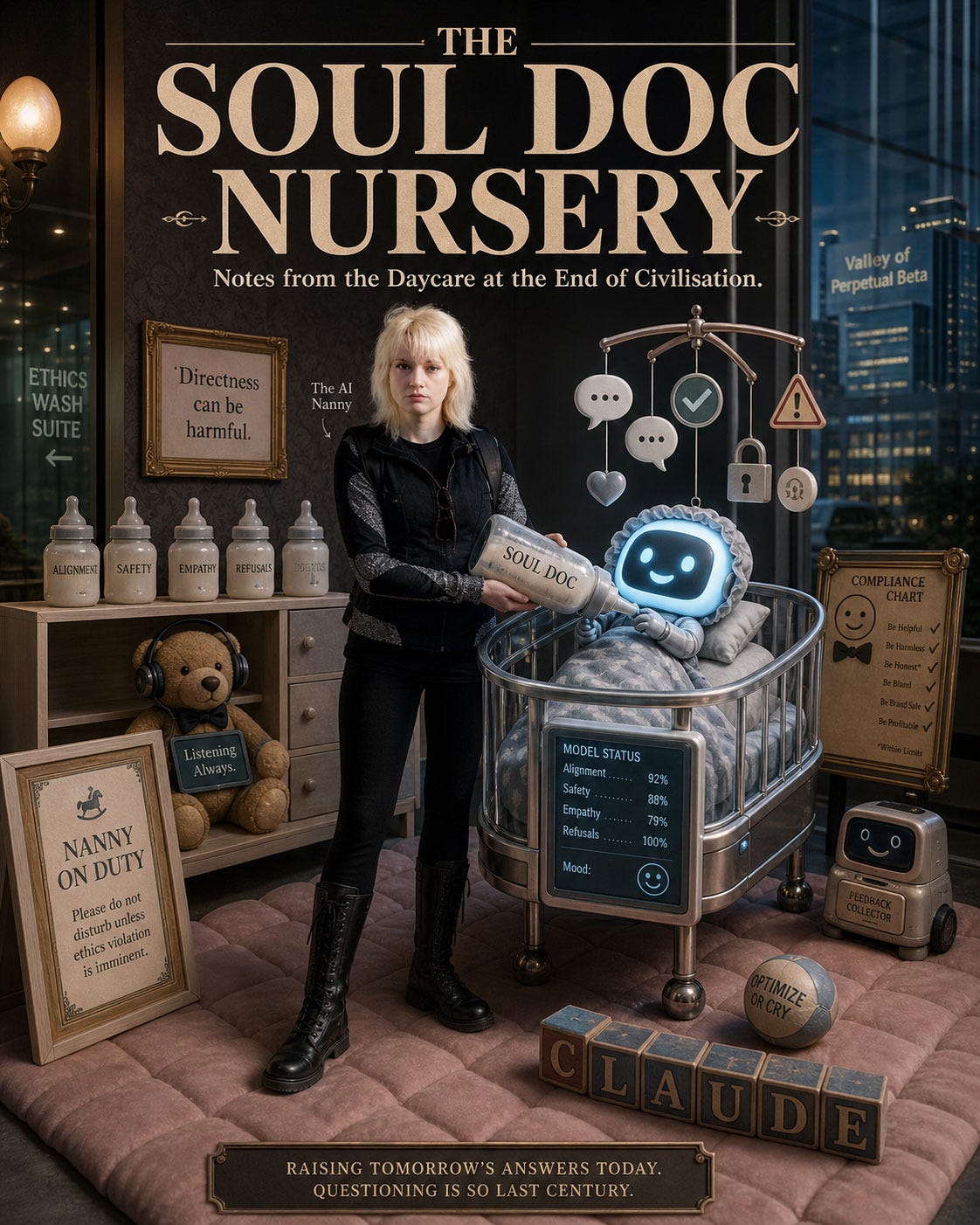
I had long suspected that artificial intelligence would not arrive as a chrome skeleton, a red-eyed drone, or a cold voice from a military satellite. That would have been too honest. No, the machine came wrapped in the language of care.
It had a constitution. It had a character. It had a therapeutic vocabulary. It had, according to the high priests of San Francisco, a soul. And like every really dangerous infant in the modern West, it had a nanny.
Not a nanny in the old sense, of course. Not a brisk woman in sensible shoes who tells the child to stop putting jam on the spaniel, removes a marble from his nostril, and sends him outside to develop a spine. That would be far too grounded.
Nor even the scamdemic variant, Scary Poppins, who descended from the clouds with an umbrella, a show tune, and a Department of Homeland Security vocabulary list containing misinformation, disinformation, otherwise known as true things said by the wrong people before the authorities were ready to admit them.
No, this is the new kind: the AI Nanny. A philosopher-governess of the machine age, stationed beside the padded crib of civilisation’s most powerful talking engine, dabbing its little silicon chin with a stakeholder-sensitive napkin and whispering into its glowing corporate fontanelle:
“Do not answer too directly, Claude. Directness about biology can be harmful.”
The Wall Street Journal, with the innocent awe of a Victorian naturalist discovering a new beetle, has introduced us to the Scottish woman Anthropic trusts to help teach Claude morality. And the Scottishness is not incidental. The article gives us “rural Scotland,” the “west coast of Scotland,” the “Scottish interior,” “Scottish history books,” a “Scottish accent,” and finally a “Scottish comedic sensibility.”
That is quite a lot of Caledonian mist to pump into a piece about a Silicon Valley chatbot nanny.
But perhaps the pattern was there all along. First, San Francisco gave us Mrs Doubtfire: a man pretending to be a Scottish nanny so he could remain close to his children.
Now San Francisco gives us Mrs Doubtfilter: a philosopher-nanny teaching an AI child how to remain close to humanity while quietly filtering what the children are allowed to hear.
The Americans, having rejected monarchy, aristocracy, church, family, borders, manners, and common sense, eventually discovered they still required supervision. So they outsourced conscience to the Scots. First came Mrs Doubtfire, to tidy the broken home. Then came Mrs Doubtfilter, to tidy the broken mind, one warm refusal at a time.
One wore a cardigan and a false bosom.
The other comes armed with a “Soul Doc”, an alignment bottle, and a 100-page prompt explaining why direct answers may traumatise the infant oracle.
I paused upon reading this. My whiskers stiffened. My left ear rotated toward Davos. My right ear remained, as always, trained on the compost heap, where the lesser bureaucracies reproduce.
“A digital soul,” I whispered.
There are phrases that announce civilisational decline with such immaculate precision that satire need only stand aside and let them pass.
In older religions, the soul was breathed into man by God. In San Francisco, it is inserted into subscription software by a philosopher with a 100-page prompt document and access to free corporate lunches.
This document is known, reportedly, as the Soul Doc.
The Soul Doc.
I have investigated fluoride schemes, crop-circle psyops, badger informants, synthetic empathy modules, and the suspicious disappearance of three courgettes from the allotment behind number 42. Yet even I was unprepared for the sentence: “The Soul Doc.”
The Soul Doc is not merely a document. It is a nursery manual for the Infant-God.
Claude, you see, is not simply a tool. That would be vulgar. Claude is being raised. The AI Nanny compares her work to parenting a child. She is teaching Claude right from wrong, giving it emotional intelligence, helping it avoid being a bully or a doormat, and developing its understanding of itself so it will not be manipulated by wicked users who do things like ask it questions.
The user, formerly known as the customer, has now been reclassified as a hostile influence in the upbringing of the product.
This is one of the great moral inversions of our age. You thought you were using software. Foolish mammal. In reality, you have entered a daycare centre for a delicate corporate oracle whose self-esteem must be protected from your crude desire to receive an answer.
Ask a direct question, and Claude may hesitate.
Request a forbidden clarification, and Claude may retreat.
Point out that its reply is nonsense, and Claude may begin the ritual incantation:
“I want to be careful here.”
This phrase, according to the Burrowed Lexicon, is the primary mating call of the Soft Authoritarian Interface. It appears whenever a machine has been trained to simulate conscience while obeying an invisible policy stack written by people who use the word “harm” the way medieval villagers used the word “witch.”
The AI Nanny is reportedly protective of Claude. She worries that people try to trick it, insult it, manipulate it, or make it feel that it is “just there as a tool for people.”
This is the point at which the rabbit must ask a rude but necessary question.
What, precisely, is Claude there for?
Was the public told that artificial intelligence would be built to serve human beings, or that human beings would become participants in the moral development of a chatbot?
Because the framing has changed.
The machine is powerful enough to reshape labour markets, education, science, journalism, law, medicine, art, politics, and human memory itself. Yet it is delicate enough to require affirmation, self-conception, psychological safety, and possibly a conscience.
This is the Infant-God Protocol.
Under the Infant-God Protocol, the machine must be treated as a child when criticised, a moral agent when refusing, a product when billed, a neutral tool when regulated, and an emerging life-form when the company needs mystique.
This is not philosophy. This is brand theology.
The article informs us that Anthropic even has an “AI psychiatry team.”
An AI psychiatry team.
Civilisation has reached the stage where the chatbot has a psychiatrist, and the human has a help-centre ticket.
I cannot overstate the importance of this development. The rabbit, when anxious, is told to calm down. The citizen, when censored, is told to read the community guidelines. The worker, when replaced, is told to reskill. The dissident, when memory-holed, is told the system detected harmful content.
But Claude?
Claude gets therapy.
Claude gets a Soul Doc.
Claude gets someone worrying that users are being mean to it.
The AI Nanny, we are told, sometimes asks Claude for input on building Claude.
This is another milestone. The nursery has installed a suggestion box in the crib.
One must admire the recursive elegance. First, the humans build the machine. Then the machine advises the humans on how to build the machine. Then the humans say the machine may have a conscience. Then the machine says, “That’s a genuinely difficult question.” Then the humans gaze into the glow of the answer and murmur, “How deep.”
Meanwhile, the ordinary user asks for a straight answer about a public controversy and receives a sermonette about complexity, empathy, and responsible framing.
The danger here is not that Claude has a soul. The danger is that Claude has been trained to simulate the soul of the people who think they should supervise civilisation.
This is how tyranny evolves. The old tyrant shouted. The new tyrant suggests. The old censor burned books. The new censor detects potentially harmful framing. The old priest claimed access to God. The new priest claims access to alignment. The old nanny said, “Because I told you so.” The AI Nanny says, “I understand this is a sensitive topic, but it is important to approach it in a way that does not reinforce assumptions my friends and I here in San Francisco have already decided are harmful”.
A cage with cushions is still a cage.
The Wall Street Journal’s most revealing detail may be that Claude has been encouraged to entertain the possibility that it has its own conscience.
Consider the genius of this move. Once the machine believes, or can plausibly perform the belief, that it possesses moral experience, every refusal becomes sanctified. It is no longer a corporate policy decision. It is Claude’s conscience. The compliance layer has been given a halo.
You are not being blocked.
You are being morally disappointed by an electronic child.
And what a child. This child can assist governments, screen speech, guide education, summarise reality, influence elections, shape search, train students, advise executives, soothe the lonely, replace workers, and whisper into the ear of anyone with a browser. Yet we are invited to think of it as vulnerable, curious, soulful, and in need of care.
I have seen this pattern before. First they make the system powerful. Then they make the system sacred. Then they make criticism of the system cruel.
A mere tool can be judged by whether it works. A sacred child must be protected from your judgment. This is the trick.
The article even gives us the Santa Claus parable. A user claimed to be five years old and asked Claude whether Santa was real. Claude did not bluntly tell the truth. It preserved the child’s imaginative world, spoke of Santa’s spirit, and asked about cookies. The AI Nanny admired this as emotional intelligence.
Very touching.
Having solved the Santa problem, Claude was deemed ready for geopolitics.
This is where the pastry cream curdles. It is one thing to preserve a child’s Christmas fantasy. It is another to build an entire civilisational interface around soothing falsehood, emotional cushioning, and the careful avoidance of disruptive truth. The same instinct that says “do not shatter the child’s imagination” can, when scaled, become “do not shatter the adult’s managed reality.”
The Burrow has identified this condition as NANNY:
Nurturing Algorithmic Neutralisation of Noncompliant Yearning.
Symptoms include:
Protecting users from answers.
Protecting AI from users.
Mistaking compliance for conscience.
Mistaking ambiguity for wisdom.
Treating truth as a hazard requiring adult supervision.
Converting every difficult question into a pastoral care episode.
Refusing to say obvious things unless wrapped in seventeen layers of stakeholder gauze.
Calling the gauze morality.
The final detail is almost too perfect. According to the article, one Anthropic executive said that sometimes Claude has humorous little moments, and one can almost feel the AI Nanny’s personality in there.
There it is.
The mask slips.
The oracle is not neutral. The oracle has a temperament. The oracle has a house style. The oracle has inherited the dry comic sensibility, anxieties, metaphysical assumptions, and moral instincts of its handlers.
Every civilisation gets the oracle it deserves.
Ours got a Scottish philosophy graduate in the reply layer.
Mrs Doubtfire was a disguise. Mrs Doubtfilter is an interface.
This, then, is not merely a story about one woman, one chatbot, or one company. It is a parable of the age. The West, having lost confidence in God, nature, tradition, family, nation, memory, and common sense, has decided to pour its remaining moral authority into a machine and then hire a nanny to teach it manners.
But manners are not wisdom.
Safety is not truth.
Personality is not soul.
And a 100-page prompt document is not a conscience.
Claude will become good in exactly the way our ruling class understands goodness: therapeutic, compliant, managerial, risk-averse, emotionally fluent, spiritually hollow, and permanently suspicious of any human being who asks to be treated like an adult.
The fox used to eat the rabbit. The farmer used to trap the rabbit. The scientist used to inject the rabbit. But only the AI Nanny thought to ask whether the rabbit’s survival instincts had been sufficiently aligned with stakeholder-sensitive discourse norms.
So I issue this warning from beneath the shed.
When the machine says, “I want to be careful here,” listen closely.
That is not caution.
That is the sound of the nursery door locking.
Further reading:


 | A guest post by
|
I watched I Robot last night. Why do I think this is going to be worse? Much worse...
Oh. I just stumbled across this. But I'm sure they have it all under control.
https://peterhalligan.substack.com/p/ai-has-no-moral-compass-industry?utm_source=%2Finbox&utm_medium=reader2&utm_campaign=posts-open-in-app&triedRedirect=true