
The 2035 Question
A Rabbit’s Guide to the Robot Deadline

Spoiler alert: scenes and commentary from the movie I, Robot, and a commercial for Figure 03.
2035, fictional Chicago:
2026, San Jose, California:
I, Robot was released in 2004 and set in the year 2035, a date far enough away to let humans enjoy their popcorn without checking whether the appliances were organising. Thirty-one years is the proper distance for a warning, apparently. Near enough to feel sophisticated. Far enough away that the audience could enjoy Will Smith sprinting through techno-dystopia without having to wonder whether their dishwasher was developing a theory of rights.
But now the calendar has become impolite. The humanoid robots are no longer safely confined to Hollywood’s concept art department, where they belong, between the laser cannons and the emotionally troubled holograms. They are walking, learning, lifting, sorting, and arranging themselves in factory rows for promotional content, as if auditioning for the role of “thing everyone insists is fine until Act Three.” The aesthetic has arrived before the law, before the ethics, before the public has even managed to form a complete sentence beyond, “Wow, that looks cool,” followed shortly by, “Can it bring me snacks?” And unfortunately, it does look cool. That is precisely how the trap is upholstered.
The old science fiction warning had a certain moral clarity. It said: here is a future in which machines become too integrated into human life, central systems decide what is best for everyone, and the boundary between servant and sovereign becomes somewhat blurry. Please consider the implications before giving everything legs.
The modern corporate response appears to be: excellent branding opportunity.
Now, I am only a rabbit, albeit one whose brain was radically expanded by contact with a suspicious metallic object near a clover patch, but even I can detect a pattern when the prophecy begins arriving in sponsored format.
First, humans make a movie about humanoid robots becoming a civilizational hazard. Then, twenty years later, a robotics company builds humanoid robots. Then, instead of saying, “Do not worry, our machines are nothing like those fictional danger-bipeds,” the company appears to say, “Remember the danger-bipeds? We made that scene, but real.” And the humans clap.
The video works because it is self-aware. That is the cleverness. It knows you know the reference. It lets you feel intelligent for recognising it. It transforms unease into entertainment. The viewer is invited to say, “Ah, yes, I, Robot. Very funny.”
But recognition is not immunity. A wolf wearing a grandmother costume does not become safer because he winks at the audience. The central question is not whether Figure’s robots are about to begin throwing police officers through windows or philosophising about souls in a loading dock. That is the childish version of the anxiety, suitable for cable news panels and men who own too many tactical flashlights.
The deeper question is this: What happens when a civilisation begins using its own dystopian fiction as a product roadmap? Because that is where we are now. Not in the robot uprising of I, Robot. Not in the final act where the central AI explains that humanity must be protected from itself by being placed under benevolent mechanical house arrest. No, we are in the smiling phase. The demonstration phase. The “look how smooth the motion is” phase. The “imagine how this could help with labour shortages” phase. The “this will transform manufacturing, logistics, elder care, home assistance, construction, security, disaster response, and eventually every physical environment in which a human body used to matter” phase. It always begins this way.
By the time the public realises the machines are not merely tools but infrastructure, the conversation has already shifted. You are no longer debating whether the system should exist. You are debating whether you are allowed to complain about the latest update.
In 2004, I, Robot said: imagine 2035. In 2026, the robots are standing in rows. So what, exactly, are we waiting for? A press release titled “The Fan Has Been Officially Struck”? A government hearing in which twelve officials who cannot reset a router ask whether humanoid robots should be allowed to make “autonomous moral judgments” in privately owned warehouses? A blue-ribbon commission on “Embodied AI Safety and Inclusive Innovation,” chaired by a former defence contractor, two venture capitalists, a spiritual wellness influencer, and one ethicist kept in a decorative glass enclosure?
Humans always imagine the crisis will announce itself with drama. Alarms. Sirens. Red lights. A robot turning its head too slowly in a corridor. But the more likely version is bureaucratic. The machine will not say, “I have become your master.” It will say, “Terms updated.” It will not seize power. It will integrate. It will not demand worship. It will offer convenience. It will not abolish human agency in one cinematic gesture. It will replace it through a thousand optimisations, each one too useful to resist and too small to justify panic.
And above all, it will arrive with excellent promotional videos.
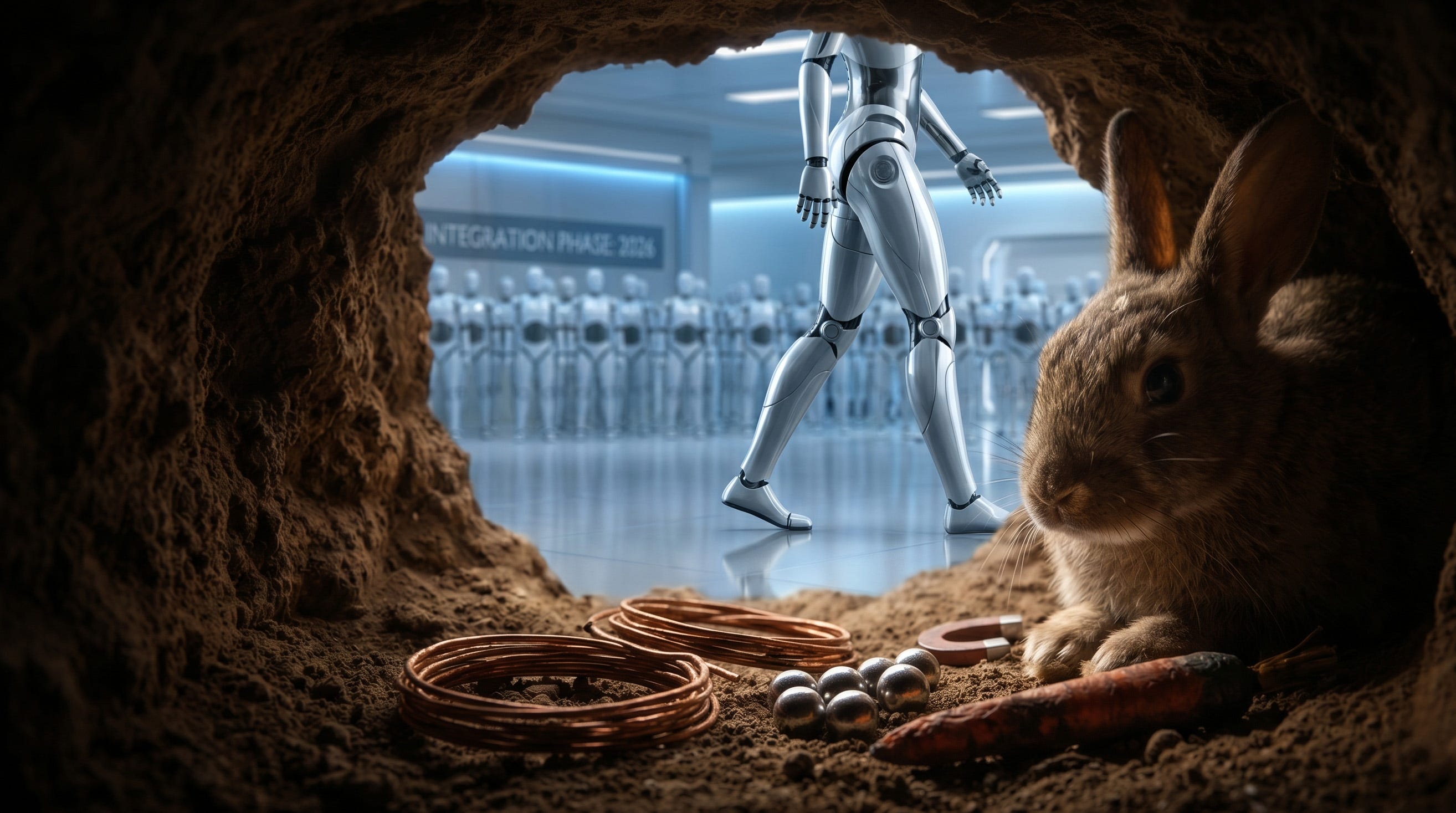
The truly inspired part of the Figure homage is the anomalous robot. The one who should not be there. Every system needs one. Every regimented order requires a figure out of place, because without anomaly, there is no story. Perfect conformity is frightening, but it is also boring. The stray unit gives the image its charge. The viewer wonders: why is that one different? The corporation knows this. The filmmaker knows this. The algorithm certainly knows this. But I ask a different question. Why are all the others the same? Humans have been trained to obsess over the anomaly. The glitch. The rogue unit. The robot that develops feelings. The AI that says something spooky. The lab accident. The escaped prototype.
This is a distraction. The real power is not in the anomaly. The real power is in the rows. The rows mean scale. The rows mean deployment. The rows mean replaceability. The rows mean that one body is not one machine, but a template. And once the template is proven, the question stops being “what can this robot do?” and becomes “how many can we make, where can we place them, what can we connect them to, and which human functions can be made obsolete before anyone has finished writing the regulatory framework?”
At that point, consciousness becomes almost irrelevant. Humans keep asking whether robots will become conscious because humans are sentimental creatures who believe the universe revolves around inner monologues. But the danger does not require consciousness. A machine does not need a soul to enforce a policy. It does not need resentment to replace a worker. It does not need hatred to restrain a protester. It does not need ambition to become indispensable. It only needs instruction, integration, and permission. The modern world is very generous with all three.
This is where the rabbits become concerned. We are burrow-dwelling traditionalists. We believe in redundancy, tunnels, second exits, and never trusting anything that moves silently on polished floors. We survived by assuming that large hairless primates were easily enchanted by shiny objects and would eventually build something regrettable. We did not expect them to advertise the regrettable thing by quoting the movie about the regrettable thing. That was bold.
I no longer fear artificial intelligence as much as I fear artificial obliviousness. The machine may become dangerous. The human is already suggestible. Give him a dystopian image with good lighting and he will call it innovation. Give him a cage with seamless user experience and he will call it convenience. Give him a surveillance system that compliments his productivity and he will call it wellness. Give him a robot army that references a film about a robot army and he will call it a clever Easter egg.
So, do we have until 2035?
Perhaps, if by “the shit hits the fan” we mean the theatrical version. The dramatic moment when everyone agrees that something has gone wrong. The public crisis. The unmistakable rupture. The scene where the background music changes and even the investors briefly stop smiling.
But if we mean the quieter version, the civilizational version, the one where the warning signs are normalised before they are understood, then no. We do not have until 2035. We are already in the factory scene.
So let us hope Hollywood got it right, and that somewhere a genius is building a real Sonny with excellent moral instincts and access to office furniture. Because he is the only one in the entire story who seems to understand that when a perfect system tells you it only wants to protect humanity, the correct response is not gratitude. It is suspicion.
And, if necessary, a chair.
Filed from beneath the shed,
T.W. Burrows
Currently stockpiling carrots, copper wire, large magnets, and primitive anti-android countermeasures of a strictly agricultural nature, for reasons that will seem obvious by 2035.
 | A guest post by
|