

Why the Problem Must Remain a Process
Toward a Trauma-Informed Defence of the Managerial Ecosystem

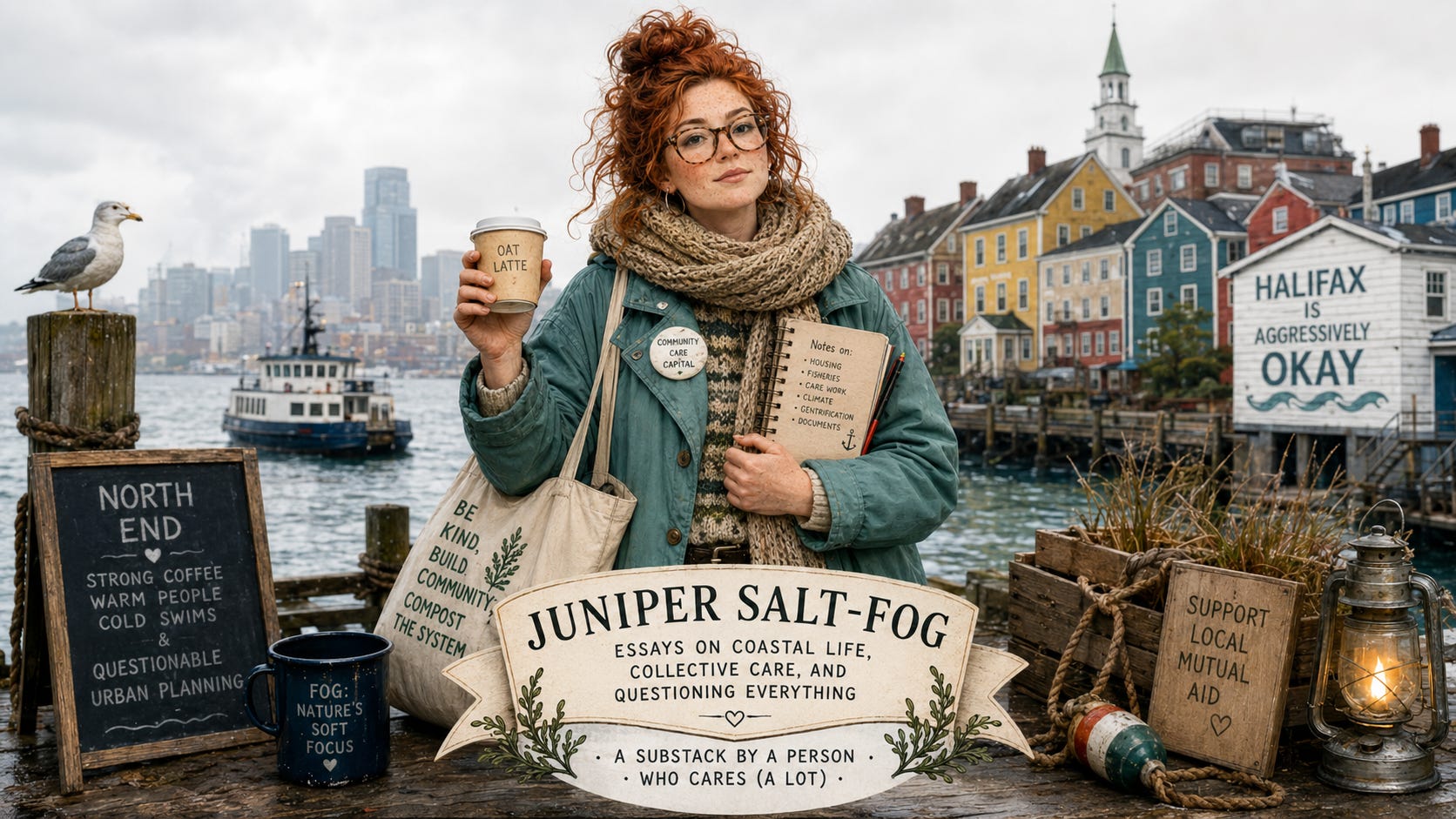
Editor’s Note: The Random Archivist is pleased, if visibly braced, to welcome Juniper Salt-Fog, based in Halifax, Nova Scotia, as a new contributing writer. Juniper writes from the liminal shoreline where fog, oat milk, municipal policy, and unresolved collective trauma gather to form what she calls “a more accountable weather system.” Her work explores decolonial lunch choices, climate grief, queer ferry schedules, community care, garlic-sauce accountability, and the hidden violence of practical solutions. She has, by her own account, studied at, audited, facilitated within, been harmed by, repaired with, or entered into accountable relationship with all seven universities in this tiny city. Yes, seven. This has left her credentialled, or at least tote-bagged, to speak on subjects ranging from fibre arts to municipal grief, ferry affect to weather-based lived experience, the coloniality of straight seams, and the urgent question of whether a donair can consent to being eaten.
(Long-time contributor, T.W. Burrows, has formally objected to her appointment, describing Juniper as “a lavender-scented compliance vole with an MFA in fog” and warning that “there can be no truce with these people.”)
Why the Problem Must Remain a Process
I am writing this from a reclaimed church pew in a North End café where the muffins are priced according to their embodied relationship with scarcity, and where a municipal planner has just used the word “emergent” with such tenderness that the oat milk briefly trembled. Outside, the fog has gathered over K’jipuktuk/Halifax in its usual non-linear way, refusing clarity, refusing speed, refusing the extractive violence of a view. The harbour has withdrawn itself from legibility. The ferry is crossing with the uneasy confidence of a municipal object that has not yet consented to being infrastructure. Somewhere nearby, a man in a ball cap is probably saying something practical, and I am trying to breathe through the implications while stirring a latte that cost almost nothing once one decentres money.
It is in this blessed administrative damp that I have been hearing, with increasing humidity, a troubling argument from certain process-skeptical commentators. The argument goes something like this: perhaps our institutions do not actually want to solve social problems. Perhaps the professional class has discovered that certain problems, if never quite stitched closed but instead held in a state of ethically facilitated fraying, can produce policy papers, academic conferences, public-sector positions, consultancy opportunities, community engagement circles, equity audits, trauma-informed lunch-and-learns, commemorative tote bags, and eventually a modest but tastefully renovated North End row house with a difficult history, excellent light, and a small plaque acknowledging the harm done by previous plaques. I want to begin by saying that I hear this concern. I also want to locate it, trouble it, ask who benefits from its tone, and then, if we still have time before the ferry, invoice it.
The suggestion that problems should be “solved” reflects a deeply colonial attachment to closure. Closure is a settler technology. It imposes linearity upon the beautiful, non-binary, compost-adjacent spiralling of social repair. To solve a problem is to silence its process. To address a problem, by contrast, is to hold space for its administrative becoming. This is why I prefer “addressing,” a word that does not imprison reality inside the carceral architecture of completion, but allows it to remain open, tender, professionally mediated, and eligible for renewed funding. A solved problem stands there rudely, like a man who has brought his own ladder. An addressed problem gathers us into relationship, gives us name tags, and asks whether anyone in the room has lived experience of ladders.
I learned this first through fibre. A seam, like a border, pretends the world can be joined by force and then declared finished. A knot, improperly facilitated, can reproduce attachment without consent. A hem is merely a shoreline that has surrendered to measurement. This is why, in my own textile practice, I have always resisted the violence of “done.” A finished blanket warms one body. An unfinished counter-blanket can reveal the colonial assumptions embedded in warmth itself, convene a sector, and support twelve months of community-rooted reflection on the politics of being less cold.
Clean water, for example, is important. Obviously. No one is saying water should not be clean. But we must also ask: clean according to whom, by which epistemology, and under what hydrological regime of knowing? Have we considered that water may not wish to be reduced to drinkability? Perhaps water is more than a resource. Perhaps water is an ancestor, a witness, a stakeholder, a wet syllabus, and, in certain grant cycles, a deliverable. A purely solutionist approach might say: fix the pipes. But a relational approach asks who we are when the pipes remain unfixed, and how their continued unfixedness might invite a deeper humility among those of us coordinating the working group. If the taps ran clear tomorrow, what would become of the water justice retreat, the youth mural, the downloadable toolkit, and the part-time coordinator whose email signature contains three territorial acknowledgements and a quote from Audre Lorde? This is not failure. This is governance.
The same applies to zero carbon. Some reactionary voices say our climate policies are making life expensive, immobilising the poor, punishing farmers, and producing a strange class of urban professionals who denounce cars while quietly borrowing their mother’s Subaru whenever there is a thunderstorm, a sale on ceramic planters, or a workshop in Tantallon requiring the transport of emotionally significant soup. But that is a shallow reading. The purpose of zero carbon is not to reduce emissions. That is merely the brochure version, printed on recycled paper by a consultant who drove there. The deeper purpose is to create a permanent ethical weather system in which every human act can be reinterpreted as either harm or allyship.
Driving is violence, unless one is transporting workshop textiles or an emotionally significant former polyamorous intimacy collaborator through freezing rain. Flying is violence, unless one is travelling to a conference on climate grief, regenerative policy, or the urgent need to reduce unnecessary travel. Eating is violence, unless the lentils have been sourced through a community-rooted food justice collective and introduced with a land acknowledgement long enough for the lentils to cool. Heating one’s home is violence, unless the home is being used as an informal care hub, zine-folding site, or emergency meeting space for people processing winter. Owning a home is violence, unless it is a co-operative, a family cottage currently undergoing decolonial reflection, or a modest North End row house held in accountable relationship with its problematic foundations. Not owning a home is also violence, but in a more structurally legible way. Carbon, in this sense, is not just a molecule. It is a moral curriculum, and the final exam is administered by someone wearing fingerless gloves indoors.
The goal is not to arrive at a stable, affordable energy system, because stability itself has fossil origins. The goal is to cultivate climate grief as a renewable civic resource. Grief can be installed anywhere. Unlike solar panels, it functions during fog. It requires no grid connection, no rare earth minerals, no maintenance crews, and no ugly confrontation with whether the lights are actually on. A kilowatt merely powers a house. Climate grief powers a sector. One keeps the fridge running. The other keeps Rowan employed.
This is why the modern university is so vital. Critics claim universities now produce too many administrators, too many activists, too many professional explainers of oppression, too many people with graduate degrees in fields that appear to exist mainly so that other people can get graduate degrees in them. But these critics miss the delicate ecology of the institution. Here in K’jipuktuk, NSCAD produces the counter-archives. Dalhousie produces the language of structural inevitability. The Mount produces the care framework. Saint Mary’s produces the community engagement posture. King’s produces the wounded relationship to Plato. The municipality produces the strategy document. The café produces the lentil soup. And together, with appropriate resourcing, we produce a city in which no pothole need suffer the indignity of being merely filled when it could instead be listened to as an infrastructural opening.
A university is not merely a place where knowledge is transmitted. That would be extractive. A university is a wetland of credentialed concern. It receives young people, softens them through theory, teaches them to detect harm in objects previously considered inert, then releases them into government, NGOs, school boards, HR departments, arts councils, public health agencies, municipal advisory committees, and the federal government, where they reproduce the conditions of their own interpretive necessity. The old economy produced goods. The new economy produces frameworks. Goods can be consumed and forgotten. Frameworks require implementation, monitoring, revision, community consultation, intersectional review, and a second framework addressing gaps in the first framework. A chair can be built once. A Chair in Decolonial Climate Queer Futurities can renew itself indefinitely, particularly if the chair never makes the vulgar mistake of becoming furniture.
Some people say this creates a self-perpetuating class. But all life is self-perpetuating. Municipal planning is self-perpetuating. Fog is self-perpetuating. Sourdough is self-perpetuating, unless neglected by emotionally unavailable asexual roommates with unresolved Capricorn energy. Why should administrators alone be denied the right to propagate? I do want to be careful with that word, of course. Propagation carries a heavy biological legacy. Many of us in the care constellation are trying to move beyond the reproductive framing of public life. We do not need programs that “deliver.” We do not need initiatives that “bear fruit.” We do not need the violent little baby of implementation placed into the arms of a community that has not consented to outcomes. We need a gentler civic non-continuance, in which each project gives birth only to the next consultation and every consultation is raised collectively by the sector. This is not sterility. It is sustainability.
The accusation is often that we “benefit” from the problems we address. But this assumes benefit is bad. I benefit from locally roasted coffee, yet I do not wish coffee to disappear. I benefit from the existence of very large scarves, but no one says I am exploiting autumn. I benefit from climate anxiety, land acknowledgements, anti-racism workshops, gender-inclusive washroom consultations, and the annual symposium on Food Justice, Embodied Resilience, and the Carceral Semiotics of Cutlery. That does not mean I created these conditions. It means I am in accountable relationship with them. If a person is paid to hold space for suffering, this does not mean suffering is their business model. It means capitalism has briefly been forced to reimburse tenderness.
Besides, what would happen if the problems were actually solved? Imagine the administrative trauma of it. No more committees, listening circles, community-engaged research, honoraria, restorative facilitation, emotionally brave PowerPoints, land acknowledgment consultants helping dental hygienists navigate treaty consciousness, municipal equity coordinators, climate resilience officers, associate vice-provosts of belonging, emergency roundtables on the whiteness of snow removal, softly lit photographs of people pointing at maps, or final reports with cover images of hands, shorelines, or children walking away from the camera toward a future that has not consented to measurable benchmarks. We would be left with ordinary citizens making decisions, solving problems, arguing about costs, and expecting visible results. That is populism, and it often arrives in dirty work boots.
I do understand the impatience. I have seen an old woman at a housing consultation ask, very plainly, whether she would be able to remain in her apartment. I have seen the room soften, then panic, because her question had arrived without sufficient abstraction. It wanted an answer. It did not want a framework. For a moment, I felt the old violence of clarity enter me. Then a municipal planner gently reminded the room that tenancy grief must be situated within a broader landscape of displacement narratives, and I was able to breathe again. Later, we formed a subcommittee to ensure that future direct questions would be supported by appropriate interpretive padding.
We must honour the non-linearity of progress. A program that fails may still succeed by revealing the need for a broader program. A broader program that fails may reveal the need for cross-sectoral alignment. Cross-sectoral alignment may reveal the need for a national strategy. A national strategy may reveal the need for regional coordinators. Regional coordinators may reveal the need for local implementation partners. Local implementation partners may reveal the need for more research. More research may reveal, humbly but firmly, that the original problem persists. This is not a circle. It is a spiral. And spirals, as many coastal cultures and mid-tier consultants have long understood, are sacred. They are also excellent for diagrams.
The same logic applies to harm reduction. The unenlightened ask whether policies reduce harm. But harm is complex. Sometimes reducing harm too quickly can harm the harm-reduction ecosystem by destabilising the practitioners whose lived experience of addressing harm is itself a form of communal care. We must not reproduce scarcity by expecting interventions to intervene. An intervention that intervenes too decisively risks becoming a solution, and from there it is a very short walk to fathers, vans, sockets, ladders, plumbers, and other forms of patriarchal immediacy.
I have heard certain practical people mutter that this is madness, to which I say: yes, but whose madness? Western rationality has long privileged crude cause-and-effect arrangements. A pipe leaks, someone fixes the pipe, therefore, water no longer enters the basement. But a more nuanced reading asks whether the leak is perhaps an uninvited facilitator of hydrological awareness. Has the basement interrogated its relationship to dryness? Has the homeowner considered whether “damage” is a socially constructed category? Might the obsession with repair reflect an internalised scarcity mindset around mould?
I do not claim to have answers. Answers are extractive. I have questions, a small grant, and a reusable tote bag from a conference in Lunenburg. Ultimately, the managerial class is not exploiting problems. We are tending them. We are protecting problems from the violence of resolution. A solved problem belongs to the past. An addressed problem belongs to all of us, forever. It has minutes. It has breakout rooms. It has a downloadable PDF. It can be cited in the next application.
I welcome your reflections, provided they arrive in a form that can be held, processed, and, where necessary, referred to a working group.

Editor’s Note: Please use kind words for Juniper. In New Canada, there are rules about such things, and several of them appear to have cancellation committees.
 | A guest post by
|