

The Pavement Was Not Ready
Why the new constabulary no longer throws suspects to the ground without first honouring their verticality.

I have now watched the video several times, and many others like it, through tears, and I must say I found it profoundly moving.
What some reactionary observers are calling “three officers failing to arrest one person” is, to my eye, a luminous glimpse of the policing future. These officers were not “incapable.” They were modelling a non-dominative, de-escalatory, gender-expansive approach to public safety in which arrest is no longer understood as the crude transfer of a body from freedom to custody, but as a relational process negotiated among stakeholders, pavement, weather, and unresolved colonial legacies.
The person on the street was not “resisting arrest.” He was participating, perhaps imperfectly, in a co-created accountability encounter. His refusal to comply should not be viewed through the outdated lens of criminality, but as a boundary statement. The officers, rather than violently imposing closure, allowed space for his nervous system to speak. This is what abolitionist-adjacent policing can look like when it stops worshipping at the altar of upper-body strength and starts listening to the pavement.
Now, some will say: if the concern is operational capacity, why not recruit more women from rugby, boxing, mixed martial arts, and other regrettably kinetic traditions? I acknowledge that such women exist. Some of them could probably fold the average pavement dissenter into a recycling bin before the first community liaison officer had located the clipboard.
But we must ask: at what cost?
To recruit women on the basis of physical dominance would be to reproduce the very high-testosterone culture policing must now gently compost. A woman in a stab vest who can double-leg a violent man into the kerb is, biologically speaking, still participating in patriarchy’s favourite grammar: force, leverage, compliance, gravity. The mere fact that she is female does not automatically cleanse the takedown of its carceral masculinist residue. It may even make it worse, because then the old culture gets to wear a new face and call itself inclusion.
The goal is not to diversify domination. The goal is to decentre it.
And in fairness, progress is being made. We should acknowledge that policing is no longer merely opening itself to women who decline the old cult of physical force. It is also increasingly welcoming men who, in earlier and more brutish eras, might have been excluded by primitive expectations around size, strength, stamina, and the ability to move one uncooperative adult from here to there. This is important. A truly inclusive police service cannot simply replace one broad-shouldered constable with one broad-shouldered constable of a different demographic profile. It must ask whether the broad shoulders were part of the problem.
Under the emerging model, half a dozen more reflective men may now be employed where one traditionally force-capable man once stood. Some call this inefficiency. I call it community. Why should one officer impose a swift physical resolution when six officers can create a temporary pavement forum around the question of whether resolution itself is merely domination wearing a watch? The old policing model fetishised the lone burly officer who could end things quickly. The new model recognises that public safety is better expressed as a multidisciplinary huddle with radios.
So no, the answer is not to fill the constabulary with female cage fighters, mat goblins, rugby flankers, and judokas with necks like municipal bollards. Nor is it to return to the distressing era of lantern-jawed men who could lift a drunk through a doorway without first consulting the doorway. That would only pander to the old high-T fantasy that taxpayer-funded public safety requires the State to be able to move a non-consenting body from standing to horizontal. We are trying to imagine something braver: a policing model in which the body is not “controlled,” but invited into accountability at a pace agreeable to its nervous system.
Yes, an old-style officer eventually arrived and used conventional physical force to bring the encounter to a rapid conclusion. But that moment should not be mistaken for success. It was a tragic relapse into legacy policing. A sort of tactical manspreading. One could almost hear the patriarchy hitting the curb.
The real achievement had already occurred before he got there. For several beautiful minutes, the public witnessed police officers courageously declining to centre domination. They did not “throw him down.” They did not “control the suspect.” They did not “resolve the situation efficiently.” They remained in relationship with complexity.
This is the new British policing. Less testosterone. More process. Less “Get on the ground.” More “Can we invite the ground into this conversation?”
And frankly, that is progress.
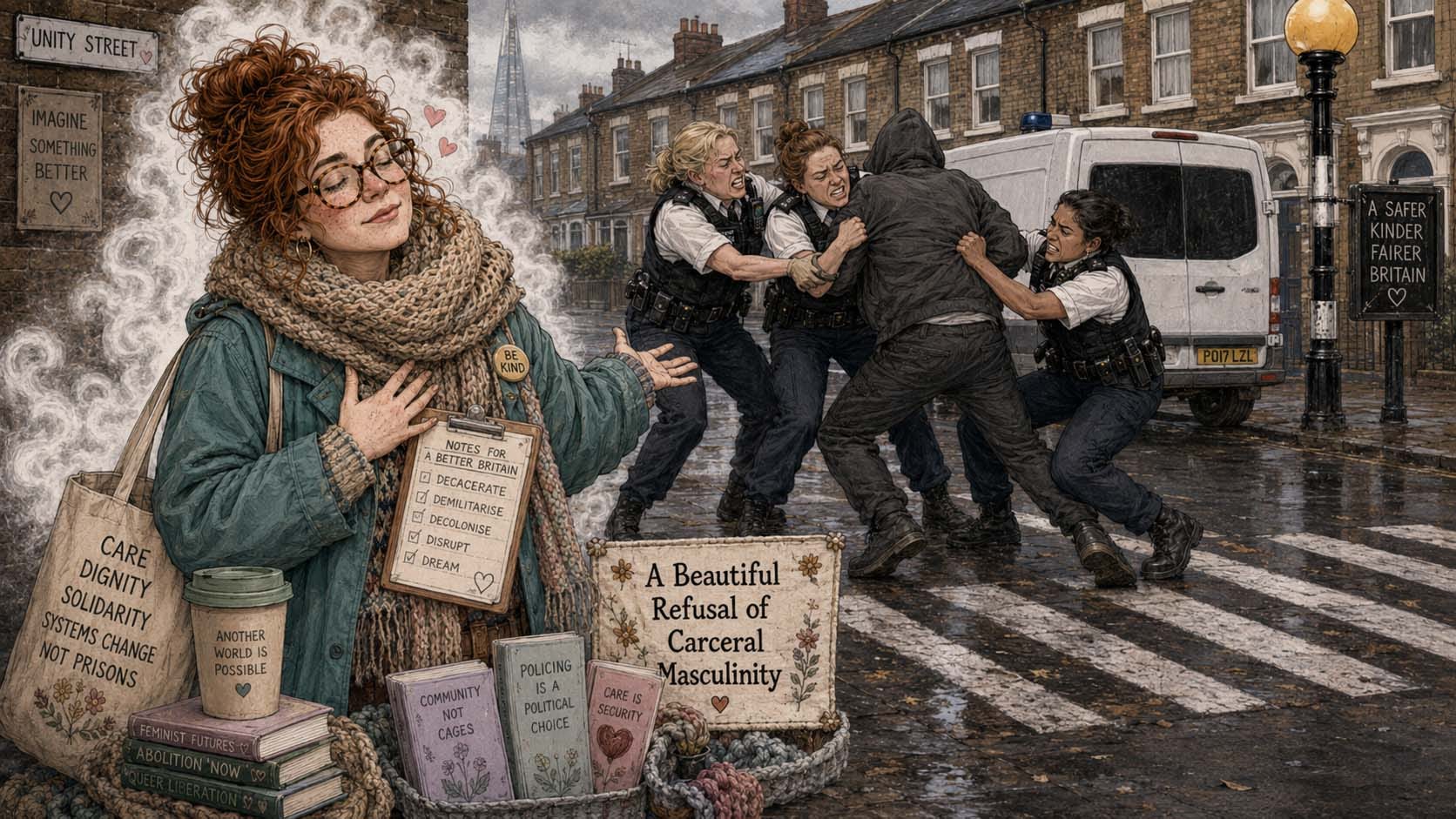
Editor’s note: Juniper is not entirely wrong; she is correct that there are many of these videos on the Internet. Britain now appears to produce them as a cottage industry, somewhere between heritage tourism and public collapse. Where I part company with Juniper is in the interpretation. She sees a beautiful new model of policing, softer, kinder, less phallocentric, in which several officers gather around one man and attempt to persuade his limbs to join the consultation. I see a police force discovering, clip by clip, that the human body remains stubbornly pre-DIE. It still has mass. It still has leverage. It still refuses to be moved by people selected mainly for their ability to complete reflective learning modules and stand bravely beside a lanyard. Gravity, alas, has not updated its values statement. And the suspect, inconveniently, does not become easier to arrest because everyone involved has attended a workshop called Courageous Conversations About Harm.
Warning: Comments are monitored by Big Sister. This is Canada, where observing that a police officer should be able to arrest an unarmed person without instantly retreating to the bullet option, and then missing, may now require legal counsel, moral laundering, or a federally funded workshop on the colonial violence of grip strength.
 | A guest post by
|