

N.B. Paid subscriptions still only $22 USD/Year.
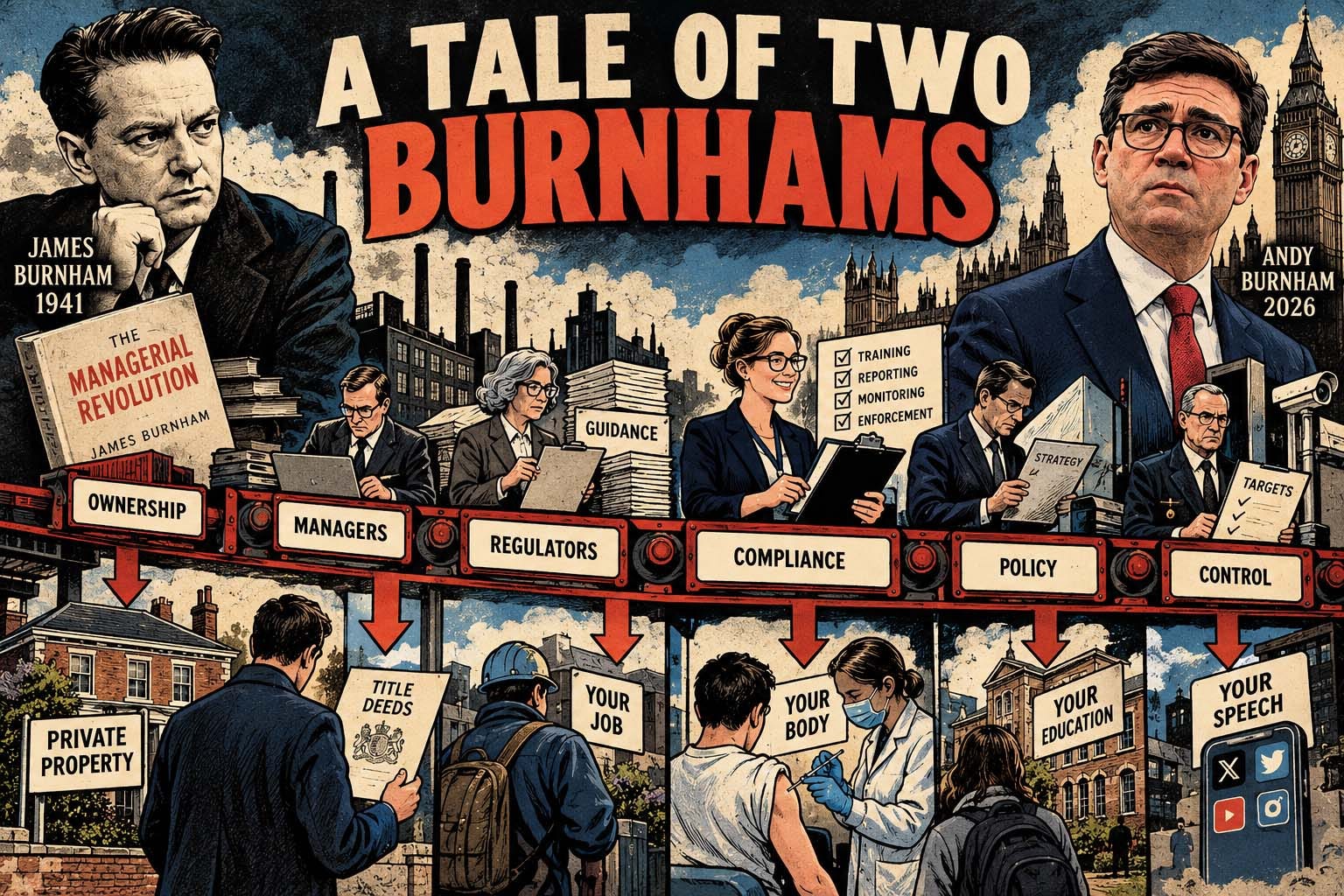
TL;DR: Britain says you can still own your house, even while the council takes over its management, installs tenants and collects the rent. During Covid, you could still own your body too, provided you were prepared to lose your job for exercising that ownership incorrectly. James Burnham spotted the trick in 1941: ownership and control are not the same thing. Gramsci supplied the institutions, Orwell saw the danger, post-Marxists widened the battlefield, Foucault explained the management of behaviour, and Majone showed how regulation could replace nationalisation.
I’m calling the resulting creature Modified Marxist Managerialism: keep private property, elections, corporations and markets on paper, then surround them with enough regulators, managers, tribunals, compliance officers and institutional rules that somebody else increasingly decides what you may actually do.
No commissar required. Ashley from Compliance has sent you a Teams invitation.
And, with historical subtlety approaching slapstick, Britain is now run by another Burnham.
Something happened in Britain today that sent me down a rabbit hole.
The Government has announced plans to make it much easier for councils to take control of privately owned homes that have been left empty. What my non-British readers might not realise is that progressivism had already got to the point in Britain where local government can take over the management of your privately owned house if you leave it empty for long enough.
Until now, a property generally had to have been empty for at least two years before a council could apply to do this. The Government is cutting that to just six months, while also removing some of the hurdles councils currently have to clear before they can act.
If a council obtains what is called an Empty Dwelling Management Order, or EDMO, you still legally own the property. On paper.
But the council can take over its management, put tenants in it and remain in control of that management for years. The council collects the rent, not you. It can then deduct the costs it is legally entitled to incur in managing the property, along with certain other permitted payments, and you get whatever is left.
In theory, that could be nothing at all.
So you still own the house. You just don’t necessarily control who lives in it, manage it yourself or receive the rent it generates.
Whatever money the homeowner does or does not eventually receive is really beside the point. The more interesting question is what the word “own” now means in Britain in 2026.
Most people understand ownership to mean more than having their name recorded on a title somewhere. They assume it means a substantial right to possess the thing, use it, decide what happens to it and benefit from it.
Once those powers can be transferred elsewhere while the state continues to reassure you that you remain the owner, the word starts doing rather a lot of work.
And I believe we saw the same phenomenon, in its most intense form, during the Scamdemic. This time it was not merely your house, business or property that remained theoretically yours while somebody else dictated the terms of its use. It was your own body.
Across Canada, the United States, Australia, New Zealand and Europe, governments made Covid vaccination a condition of continuing to perform large categories of work. In Canada, federal public servants who refused vaccination or refused to disclose their status could be placed on leave without pay. In the United States, President Biden ordered federal agencies to require Covid vaccination for federal employees, subject to legal exceptions. In Australia, Victoria required workers on its extraordinarily broad Authorised Worker list to be vaccinated if they wanted to continue working on site. New Zealand law stated baldly that an affected person “must not carry out certain work unless they are vaccinated.”
And this was hardly confined to the English-speaking world. France imposed a legal vaccination obligation on health and care workers. Italy went further still for health professionals: vaccination was legally declared an essential requirement for practising the profession, with non-compliance capable of resulting in suspension from professional practice.
The precise legal machinery differed from country to country, but the underlying mechanism was remarkably similar. Nobody formally claimed ownership of your body. Governments could continue to insist that vaccination remained, in some ultimate sense, your choice.
You could say no.
You just had to be prepared to lose your income, your job, or the career you had spent years building. Not to mention the ability to feed your family.
I know. I was one of them.
That was the ownership-and-control distinction stripped of every abstraction. Your body remained yours in law, but institutions could attach such severe consequences to exercising control over it that the practical meaning of autonomy became rather different from the theoretical one.
You still had bodily autonomy, they said.
On paper.
Just as you still own the house.
And that, I think, is the larger phenomenon I have been trying to put my finger on for years.
I’m going to call it Modified Marxist Managerialism.