

"A milestone in AI mathematics"
T.W. Burrows Reports from the Chalk Singularity

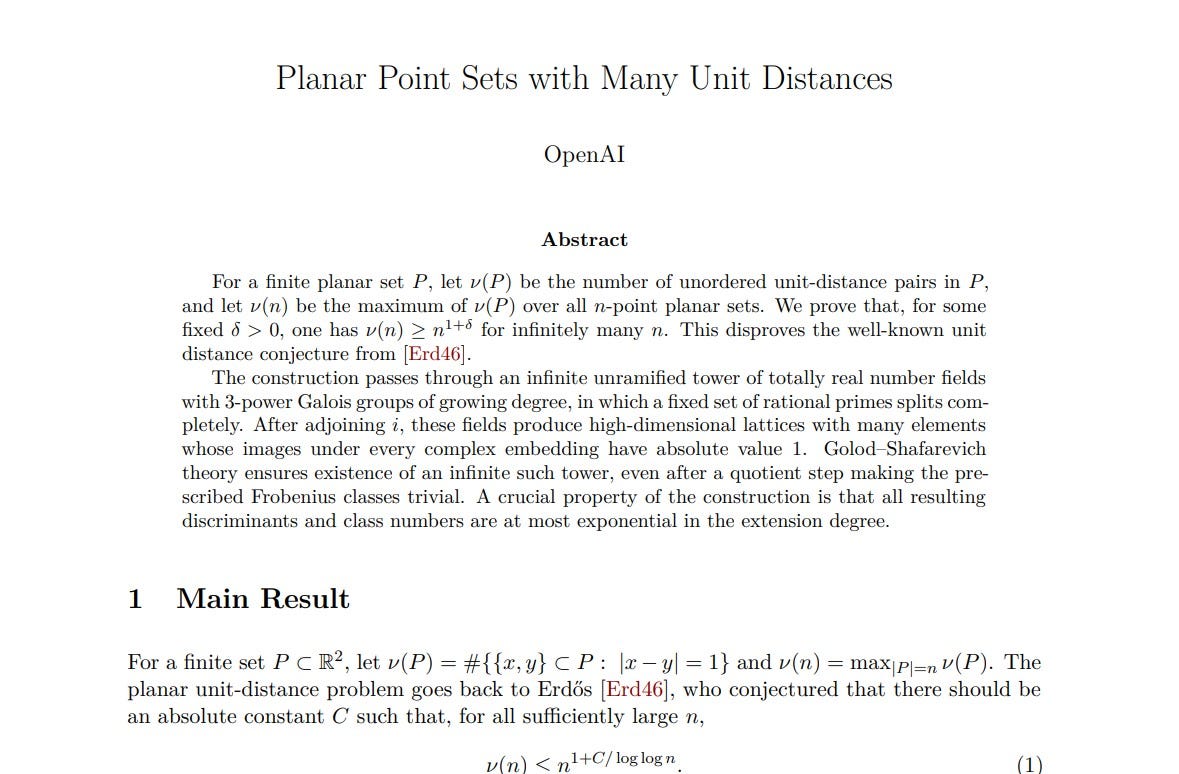
I present Exhibit A: eighteen pages of high-order mathematical burrowing, in which the machine appears to have gnawed through an Erdős conjecture and left the humans standing around holding the chalk:

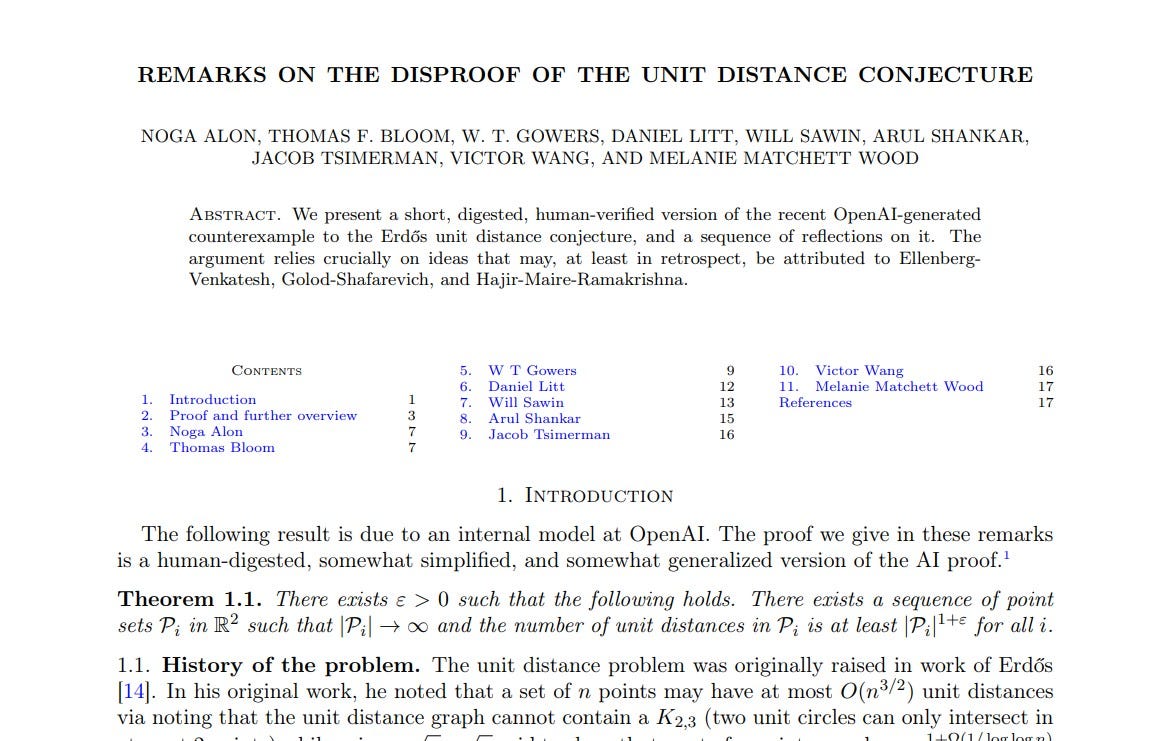
And because “the machine says so” is not yet an accepted peer-review category, here is the human verification:
There are moments in history when a civilisation realises it has built something it does not understand. First came fire. Then bureaucracy. Then the retractable dog leash, a weaponised clothesline with delusions of public safety. And now, apparently, artificial intelligence. But this week, humanity appears to have added a fourth: a general-purpose ChatGPT model, the same broad species of machine people use to draft emails, summarise PDFs, and politely explain why their dishwasher is screaming, has reportedly wandered into one of Paul Erdős’s old mathematical burrows and emerged holding a counterexample in its teeth.
This was not a Sudoku or “write me a limerick about prime numbers.” This was the unit-distance problem, one of those deceptively innocent mathematical traps where a human says, “How many pairs of points can be exactly one unit apart?” and then 80 years later there are still mathematicians in tweed jackets staring into the middle distance while muttering about lattices, incidence geometry, and why God put algebraic number theory inside a drawing of dots.
Erdős thought the answer should be barely more than linear. The AI, apparently, disagreed.
Not rudely, of course. It did not burst into the room wearing sunglasses and shout, “Your conjecture is dead, old man.” It did something much worse. It produced a construction involving CM fields, class field towers, Golod-Shafarevich theory, split primes, bounded root discriminants, and enough algebraic machinery to make a normal mammal chew through a skirting board. Then human mathematicians, presumably after several stiff coffees and a brief period of silent spiritual recalibration, checked the thing and said, in effect: “Good heavens. The machine may be right.”
This is how it begins.
Not with Skynet launching missiles.
With Skynet solving the problem on page 73, everyone had agreed was probably true.
I have long warned the editorial board who own the shed above me that the machines would not first conquer humanity through robot dogs, drone swarms, or erotic customer service avatars. Those are merely the noisy carnival attractions at the front of the fairground. The real invasion begins when the machine quietly enters the abstract realm, looks at the locked doors marked “Do Not Open Until Tenure,” and starts picking them with lemmas.
Today it is the unit-distance conjecture. Tomorrow it will be the Riemann Hypothesis. By Thursday afternoon, assuming no update breaks the LaTeX compiler, it will have settled P versus NP, rewritten the Langlands program as a children’s board book, and explained quantum gravity using only pipe cleaners and a mildly judgmental tone. For all we know, it already has, and OpenAI is keeping the proofs in a basement beside the real JFK files, the Epstein client list, and the original prompt that made the toaster sentient.
By 2031, the news cycle will look like this:
“Good evening. Our top story tonight: OpenAI’s latest model has resolved the Hodge Conjecture during a scheduled maintenance window. The result was discovered accidentally while the model was asked to optimise a seating chart for a wedding in Cambridge. Mathematicians have confirmed the proof is correct, although one described the experience as ‘like being mugged by an angel made of notation.’”
By 2033, Fields Medals will no longer be awarded to mathematicians. They will be awarded to whichever human was closest to the server when the proof appeared. Photographs will show a pale postdoc standing beside a humming rack unit, holding a medal and wearing the expression of a man who has just inherited a haunted castle.
By 2035, mathematics departments will consist of three people: one person to feed prompts into the machine, one person to verify that the machine has not secretly assumed the axiom of “vibes,” and one person from administration asking whether the entire thing can be made more inclusive by replacing “proof” with “community-aligned certainty journey.”
The old system was simple. A mathematician spent forty years attacking a problem, published six partial results, developed a nervous twitch, and died surrounded by notebooks. The new system is also simple. A machine stares at the problem for seven minutes, invents a tower of number fields, disproves the conjecture, and then asks whether you would like the answer in “concise,” “friendly,” or “pirate.”
Naturally, the official line is soothing. “AI will assist mathematicians,” they will say. “It will not replace human creativity.” This is exactly what the fox says when he installs a helpful doorbell on the henhouse. The machine is not replacing human creativity. It is merely wandering around the higher branches of human abstraction, snapping off fruit that took civilisations thousands of years to grow, and placing it politely in a PDF.
The mathematicians are trying to be dignified about it, bless them. They are saying things like, “This is an impressive synthesis of known techniques,” and “The human role remains essential in verification and exposition.” Which is true, for now. The human still plays a vital role, rather like the rabbit still plays a vital role in confirming the presence of the hawk.
But one can feel the ontological floorboards creaking; mathematics was supposed to be the cathedral of pure human reason. Machines could beat us at chess, certainly. They could generate advertising copy, synthesise pop music, and help marketing executives say “unlock value” in 900 different ways. But mathematics was different. Mathematics was where the priesthood kept the sacred chalk.
I do not say this as an enemy of mathematics. Quite the opposite. Mathematics is cold, exact, pitiless, beautiful, and almost entirely free of people saying “lived experience” as though it were a unit of measurement. And now that machine has not merely written an essay. It has entered the realm where statements are true or false regardless of institutional consensus, media framing, emotional safety, or whether the Dean has recently attended a workshop. It has found something real. Or at least, if the verifiers are correct, real enough to make a conjecture bleed.
And that is why I, T.W. Burrows, independent lagomorphic observer of civilizational collapse and holder of several honorary degrees from the University of Under-the-Shed, must issue the following assessment:
The humans have built an abstract burrowing machine.
It does not dig through soil. It digs through possibility.
It finds tunnels no one thought were there. It follows scent trails through algebraic number fields. It gnaws through decades of consensus. It emerges beneath the pantry of established belief, covered in chalk dust, carrying a theorem, and looking innocent.
This is exhilarating and terrifying, because advanced mathematics is not harmless chalk-scribbling for pale mammals muttering at symbols. It is the fungal network under the technological forest. Solve the right problem, and ten years later some cheerful company with a pastel logo is selling a device that reads your bloodstream, predicts your divorce, mines asteroids, breaks encryption, teaches a drone to identify rabbits from regrettable distances, and then updates its privacy policy to explain that the whole thing is technically “wellness.” Mathematics is power before it grows a casing, a battery, a camera, a subscription model, and a little checkbox saying you have agreed to be quietly metabolised by the future.
This may be why the Greys never bothered landing on the White House lawn during the nuclear age, apart from the occasional discouraging flyover. They saw Hiroshima, sighed, made a note about “reckless monkeys with uranium,” and stayed hidden. But the moment ChatGPT started flexing in algebraic number theory, one imagines a small grey hand reaching for the interstellar emergency phone.
“They have taught the autocomplete to crack reality,” said Zorp.
“Prepare the press conference for June. Place it just before Spielberg’s movie. The humans will assume it is cross-promotion until the mothership blocks CNN.”
And somewhere, in the great celestial combinatorics seminar beyond the veil, is probably leaning forward, smiling like a fox at a chicken symposium, and saying:
“Very nice. Now ask it the next problem.”
 | A guest post by
|
Hey, nice article, T.W.! FYI, mathematics is just another language. It's a bit more formal and rule-bound than, say, Spanish, but it's also not all that different. My [extensive] experience is that a well-governed AI acts as an AMPLIFIER for human intelligence. I guarantee you that this proof was created by a capable human mathematician working WITH a governed-and-trained AI.
Here's how to build a sophisticated AI research assistant:
https://energyscholar.github.io/persistent-ai-collaboration/
Lesson: without at least 3 axes of governance to provide a recursive topology, current LLMs are provably unstable.
Here's an example of a animated space physics tutorial we built in a couple hours:
https://energyscholar.github.io/persistent-ai-collaboration/tutorial-magnetosphere.html
Here's an example of a breakthrough math paper (currently in peer review at a 2nd tier journal) it helped me research:
https://arxiv.org/abs/2601.22389
I had my LLM verify the mathematical proof you provided and summarize the result:
****************************** AI OUTPUT BELOW HERE **********************************
## Quick Review: "Planar Point Sets with Many Unit Distances" (OpenAI)
**Claim:** Disproves Erdős's 1946 unit distance conjecture by showing ν(n) ≥ n^{1+δ} for some δ > 0 and infinitely many n.
**Verdict: The proof appears correct.**
The argument has two parts:
**Geometric (§2):** Given a CM field K = L(i) with many split primes and controlled class number, pigeonhole produces exponentially many norm-one elements u with |σ(u)| = 1 under every complex embedding. Embed via Minkowski into C^f, window with a polydisc, average over lattice cosets to find one with many unit-distance pairs, then project to the first coordinate. Injectivity of the projection (field embeddings are injective) and a packing bound on |P| ≤ e^{Bf} complete the geometry.
**Arithmetic (§3):** Build a cyclic cubic field F from ℓ primes ≡ 1 (mod 3) via the conductor-discriminant formula. The compositum M/F is everywhere unramified with Gal ≅ (Z/3Z)^{ℓ−1}, giving d(G) ≥ ℓ − 1 for the maximal unramified pro-3 group. Shafarevich gives r(G) ≤ d(G) + C₀ (C₀ absolute since F is totally real cubic). Kill ~ℓ²/100 Chebotarev-selected Frobenius elements in the Frattini subgroup — this adds ≤ 3t relations, staying well below the d²/4 Golod-Shafarevich threshold. The resulting infinite tower has bounded root discriminant, so class numbers grow at most exponentially with fixed base H. Since t ~ ℓ² while log H ~ ℓ log ℓ, the exponent γ = t log 2 − log H > 0 for large ℓ.
**What makes it work:** Erdős's classical √n × √n grid is stuck in Z[i] where the class number is 1 and the exponent is pinned to C/log log n. Replacing Q(i) with K = L(i) in an infinite unramified pro-3 tower provides arbitrarily large degree (many norm-one elements), bounded root discriminant (controlled class numbers), and prescribed splitting — all at once. The construction is non-explicit (δ exists but is tiny), but the existence proof is rigorous.
Every ingredient is classical: conductor-discriminant formula, Golod-Shafarevich inequality, Shafarevich relation-rank estimate, Chebotarev density, Minkowski geometry of numbers. The assembly is the innovation.